Event 1
West Point affair
The [West Point affair](entity:event-recall-event-west-point-affair-f0e7a69a2d65) is the investigation prompted by [Cadet Leroy Fry](entity:character-recall-character-ec8ccc70dbd2)’s death, the removal of his body from the Academy, and the discovery that his heart had been taken. Its opening disclosures turn an apparent suicide into a grave offense against the institution and place [Augustus Landor](entity:character-recall-character-augustus-landor-78f08974a4bb) at the center of an inquiry whose perpetrator and circumstances are not yet known.
## Background and First Signs
Landor dates his professional involvement in the affair to the morning of [October 26, 1830](entity:time-recall-time-october-26-1830-06a9561cb759). He was taking his usual walk, later than usual, in the hills surrounding [Buttermilk Falls](entity:location-recall-location-buttermilk-falls-dcb4b7c5d975). His route led toward the granite promontory known locally as Shadrach’s Heel. On the way, he heard a French horn sounding from far to the north. The sound was familiar to someone living near the Academy, but that morning it caught his attention in a new way: he began wondering how far a horn could carry.
In recounting this walk, Landor presents it as a measure of his state of mind, not as an explanation for what had happened to Fry. He also notes that he turned back before reaching the summit and was slow to understand the significance of wheel traces. The affair therefore opens with an investigator whose attention is already unsettled, and with physical traces that have not yet become a clear account of events. The distinction matters: at this stage, unusual signs invite questions, but do not establish who acted or why.
## Fry’s Death and the Missing Body
The first decisive disclosure comes from [Hitchcock](entity:character-recall-character-hitchcock-08b7f194a2d4): [Leroy Fry](entity:character-recall-character-leroy-fry-c643aeb3e4e0) hanged himself the previous night. Landor responds with sympathy, but the news does not close the matter. Hitchcock tells him that the body was removed during the night, between half past two and three o’clock in the morning. The time gives the disappearance a narrow interval, while the removal itself changes the meaning of the death for those investigating it. Fry is no longer only a cadet who died by his own hand; what happened to his remains demands a separate explanation.
Landor describes the moment as if he had arrived at the end—or perhaps the beginning—of a larger joke, and says that the safer course seemed to be to play it out. The response captures the unstable character of the first disclosures: each answer opens a more disturbing question. His attention also turns inward, to the beat of his own heart, as the word “removed” registers. The narration links the investigation’s external mystery to Landor’s bodily awareness without resolving that mystery for him.
Thayer then states the most shocking fact plainly: Fry’s heart was carved from his body. The report makes the removal more than an unexplained disappearance. It identifies a deliberate violation of Fry’s remains, while leaving the responsible person, purpose, and circumstances undetermined. The sequence of disclosures is important: suicide is announced first, disappearance next, and the taking of the heart only after that. What initially sounds like a tragic death becomes an offense that demands an investigation of its own.
## Institutional Stakes and Landor’s Charge
The affair places Thayer under pressure as well as Fry’s death. Thayer acknowledges that he has been attacked as a tyrant and despot, and Landor raises the danger that Fry’s death might be interpreted as evidence that cadets were breaking down under a brutal regime. Thayer replies that news of Fry’s death has already spread and that he cannot control how people construe it. His immediate concern is to keep the investigation out of the hands of certain parties; their identities are not specified in these disclosures.
Thayer’s response marks a conflict between the search for responsibility and the Academy’s vulnerability to public interpretation. The death can be read as an individual tragedy, as an institutional indictment, or as both. Thayer cannot prevent those readings, but he can seek to control who conducts the inquiry. His concern does not erase the offense against Fry; it establishes the institutional conditions under which Landor is asked to investigate it.
Thayer describes Fry’s death by his own hand as already difficult to bear, and the offense against his defenseless body as beyond sufferance. He calls it a crime against nature and a strike at the heart of the institution. If a passing outsider committed it, he leaves the matter in God’s hands; if one of the Academy’s own people is responsible, he insists that the offender must be removed from [West Point](entity:location-recall-location-west-point-82514378f844), whether in irons or free. This is a declared consequence, not a finding about the culprit.
Landor’s charge is to discover who committed the offense and help ensure that it never happens again. The assignment makes the affair an inquiry into both an individual act and the safety and standing of the Academy. At its opening, however, the known facts remain limited: Fry died by suicide, his body was taken during a specific overnight interval, and his heart was removed. The investigation begins in the gap between those established facts and the still-unknown person and purpose behind the desecration.
Event 2
Death of Cadet Leroy Fry
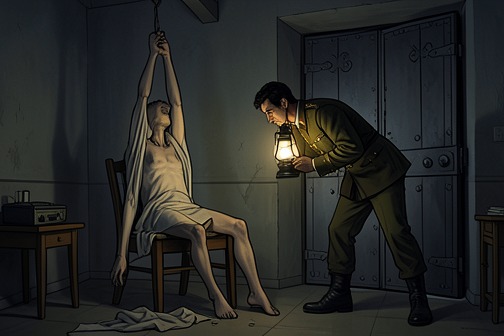
The [Death of Cadet Leroy Fry](entity:event-recall-event-death-of-cadet-leroy-fr-ca9d271f3b1e) begins with a blunt report of a hanging and becomes a forensic puzzle: the marks on Fry’s body suggest struggle, while the missing heart makes the apparent suicide impossible to accept at face value. Through [Augustus Landor](entity:character-recall-character-augustus-landor-78f08974a4bb)’s retrospective account, the event’s first force comes from the collision between an official-sounding conclusion and physical evidence that refuses to fit it.
## Discovery and First Impressions
[Captain Hitchcock](entity:character-recall-character-captain-hitchcock-7b79a53dd1d3) tells Landor that [Leroy Fry](entity:character-recall-character-leroy-fry-c643aeb3e4e0) hanged himself the previous night. The news is delivered in the presence of [Sylvanus Thayer](entity:character-recall-character-sylvanus-thayer-e0a52d824c77), whose steady attention to Fry gives the announcement the weight of a matter already under close scrutiny. Landor registers the strange sense of having arrived at either the end or the beginning of a larger joke, then offers his sympathy; the uncertainty in that reaction anticipates the investigation’s challenge to the first account of Fry’s death.
The next morning, Landor and his companions are led through the new [West Point hospital](entity:location-recall-location-west-point-hospital-15760190d8ec) to Ward B-3. The hospital is ordinarily ready to receive visitors, but the scene has unsettled its staff: one matron has fainted, while the other, too harried to explain, leads them upstairs, draws the linen sheet from Fry’s body, and leaves them alone. The body lies on a blacksmith bed beside an open fireplace. This clinical setting, newly scrubbed and orderly, offers no protection from what the sheet reveals.
Fry’s hand rests at his groin, the other is clenched, and his eyes remain half open. His mouth is twisted, two yellowish front teeth jut from his upper lip, and his neck is marked red and purple with black streaks. His chest has been torn or opened, its surface showing several different shades of red. Landor’s first comparison is to an immense concussive force, a conjecture that registers the violence of the wounds rather than establishing their cause. At this stage, the visible injuries are horrifying but not yet an explanation.
A closer examination gives the neck marks a different meaning. Landor pulls Fry’s eyelids down, but they spring back up; then he traces the lacerations and recognizes that the rope has not left one simple band. It has gouged and chafed back and forth, forming a weave along the neck. Landor reasons that this damage accumulated before the noose finally closed Fry’s windpipe. When he asks whether the searchers are looking for a man or a heart, [Hitchcock](entity:character-recall-character-hitchcock-08b7f194a2d4) can report only that the grounds have been searched and nothing found. The absent heart thus enters the inquiry alongside the rope marks: the hanging may describe how Fry was found, but it does not settle how he died.
## Reconstructing the Hanging
Landor tests the suicide explanation against the circumstances it would require. If Fry had chosen to die, Landor reasons, he might have left a note to explain himself and make his unheard grievances known. No note has been found. Nor does the body appear to him to have reached the tree by a simple, voluntary route: the marks on Fry’s neck and hands suggest resistance, while the position of his feet raises the possibility that he died with them still on the ground. Each point is an inference, not a complete reconstruction, but together they make the easy account increasingly difficult to sustain.
To demonstrate what the rope marks might mean, Landor removes his jacket, rolls up his sleeves, and plunges a hand into the alcohol bath. He hauls Fry’s head toward the surface; the stiff body rises with it, and Landor has to brace it with his other hand to keep it from sinking. Examining the neck, he emphasizes that the rope did not leave a clean, even cinch. It had run up and down, catching and scraping for a hold. Landor reads this irregular track as evidence that Fry fought the noose rather than calmly placing himself in it.
The hands and the back of the head add further questions. [Dr. Daniel Marquis](entity:character-recall-character-dr-daniel-marquis-81ad8674de23) identifies a contusion, a raised lump roughly a quarter inch above the skull. Landor asks whether it might have been inflicted after death. Dr. Daniel Marquis explains that a bruise forms when blood escapes from its vessels, and that without circulation such bruising is not likely. The distinction matters: if the contusion formed while Fry was alive, it cannot be dismissed as damage caused after his death or during later handling. It points to an injury sustained before the hanging was complete, though it does not identify who caused it.
Landor lays the facts out for Captain Hitchcock and Dr. Daniel Marquis: Fry had told no one he wished to die, left no note, apparently died with his feet on the ground, and bore a head contusion, blisters on his fingers, and rope burns running along his neck. His question is not yet who killed Fry, but whether these circumstances describe a man going willingly to his death. When pressed to state what he believes happened, Landor offers a provisional theory: someone struck Fry on the back of the head, put the noose around his neck, and pulled it tight. He marks this as a theory rather than proof. The investigation has overturned the certainty of suicide without yet supplying a named assailant, a motive, or a fully recoverable sequence of events.
## A Later Contrast with Ballinger
In a later review of the two bodies, Landor asks a witness who had seen both what distinguished [Randolph Ballinger](entity:character-recall-character-randolph-ballinger-1ea8069820e4)’s condition from Leroy Fry’s. The clearest difference was height: Ballinger had been found hanging much higher than Fry, with his feet off the ground. His wounds were already on him when the body was discovered; he had been killed and cut open before being strung up. The height made it nearly impossible for those injuries to have been inflicted afterward, and the hanging could not plausibly have been a suicide. The comparison sharpens the significance of Fry’s low position and the marks of resistance on his neck, while keeping the two deaths from being treated as identical scenes.
The later account also shows how much remained uncertain at a crime scene. Ballinger’s tree stood about three hundred yards from his sentinel post, and the witness could not tell whether Ballinger had come there willingly, been dragged, or was alive when he arrived. A storm had churned mud and snow under the feet of many soldiers, leaving tracks that could not be distinguished. This contrast does not identify who killed Fry or supply a complete account of his final movements; it instead places the hanging within an investigation where physical evidence could overturn appearances, but damaged scenes and missing traces still limited what could be proved.
## The Missing Heart and the Limits of the Case
The search for Fry’s heart gives the investigation a second question alongside who may have killed him: what was done to his body after or around his death? Landor’s distinction between searching for “A man? Or a heart?” refuses to let the hanging account stand as a complete description of the event. Yet the missing organ does not, by itself, identify its remover or explain the purpose of its removal. Fry’s death therefore remains an evidentiary threshold rather than a solved case: the physical signs make a simple suicide account untenable, while the absent heart points toward an additional act whose agent and meaning must still be established.
Event 3
Removal of Leroy Fry's heart
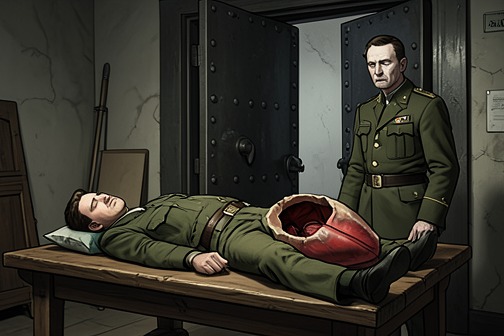
The removal of [Leroy Fry](entity:character-recall-character-leroy-fry-c643aeb3e4e0)’s heart is the crime that turns a cadet’s death into a mystery of deliberate bodily desecration. Between half past two and three o’clock in the morning, while Fry’s body was supposed to be under guard, it vanished; it was later found by the [Icehouse](entity:location-recall-location-icehouse-d2530815eb05), returned, and discovered to have been opened so that its heart could be taken.
## The disappearance and its discovery
The first breach was not the removal of the heart but the disappearance of the body. [Captain Hitchcock](entity:character-recall-character-captain-hitchcock-7b79a53dd1d3) explained that the sergeant assigned to watch it had left his post, mistakenly believing he was needed elsewhere. By the time he returned and the error was discovered, Fry’s body was gone. The narrow time window—between 2:30 and 3:00 a.m.—made the lapse more than a failure of routine: someone had exploited the absence of the guard to carry out an act that could not be dismissed as a prank.
The body was located by the Icehouse and eventually returned. [Sylvanus Thayer](entity:character-recall-character-sylvanus-thayer-e0a52d824c77) stated the injury plainly: Fry’s heart had been carved from his body. The stark announcement gave precise form to what Captain Hitchcock struggled to describe as a uniquely terrible desecration. The body’s return did not undo the violation; it made the missing organ, rather than the missing corpse, the investigation’s defining fact.
## Forensic clues and the scene of removal
When [Augustus Landor](entity:character-recall-character-augustus-landor-78f08974a4bb) examined the body, he plunged his hand into the alcohol bath and hauled Leroy Fry up by the head, bracing the corpse with his other hand so it would not sink again. The neck showed no clean, even cinch: the rope had run up and down, searching for a hold. Landor read the irregular marks as evidence that Fry had struggled against hanging, while the corpse’s rigid posture and the marks on its fingers sharpened the question of how he had died before his heart was taken.
A lump on the back of Fry’s skull offered another clue. [Dr. Marquis](entity:character-recall-character-dr-marquis-a3db786b9ae0) identified a contusion raised roughly a quarter inch above the skull and explained that a bruise formed when blood escaped its vessels. Since circulation had ceased, he judged that such a bruise was not likely to have been inflicted after death. The observation did not by itself identify the assailant or establish precisely when the blow occurred, but it made the body a record of injury as well as a site of desecration.
The search for the place where the heart had been removed began with a change in vantage point. Near the Icehouse, Landor marked out an area roughly twenty yards square, just north and slightly northeast of its door. The officers’ quarters lay northwest, the cadet barracks west, the Academies south, and the guard post at [Fort Clinton](entity:location-recall-location-fort-clinton-dbc4a72c5a9a) east. From that position, the location appeared deliberately chosen: it offered concealment from the surrounding posts and buildings. Landor had already searched around the Icehouse on his hands and knees, but had missed the site until reconsidering the ground from a different angle.
Landor and [Edgar Allan Poe](entity:character-recall-character-edgar-allan-poe-7cdacbfd7656) treated the scene as possible evidence of a rite. Fry had once joined a group the narrator describes as bad company before turning to the [Prayer Squad](entity:organization-recall-organization-prayer-squad-9b95174d0d56); the removed heart and the condition of the body had also prompted religious associations. Landor reasoned that anyone who had arranged stones or candles ceremonially would probably carry them away afterward, but might leave their impressions in the ground. With a pencil and notebook, he moved in a wave pattern among the small white stones scattered through the pale grass, measuring distances and plotting them as a lattice of dots. The search thus shifted from looking for objects that were no longer there to reading the marks their arrangement might have left behind.
## The missing organ as clue and symbol
The opened chest made absence more vivid than any surviving wound. Landor could see the shivered ends of the bones, the folded tissue, the shriveled lungs, the diaphragm, and the liver; what fixed his attention was the organ that was no longer there. In his account, Fry seemed reduced to a question posed by the body itself. The heart’s removal therefore works on two levels: it is a concrete act investigators must explain, and an absence that turns the corpse into an unresolved demand for an answer.
That absence also steered the investigation toward ritual without proving a religious motive. Landor recalled that Fry had once associated with a disreputable group and later joined the Prayer Squad; the condition of the body had likewise suggested religious fanaticism to Thayer. Treating religion as a possible starting point, Landor asked whether stones or candles might once have marked a ceremony. He reasoned that the objects could have been removed to conceal evidence while their impressions remained in the ground, and searched for those traces with Poe. The theory arose from the scene’s missing heart and the possibility of deliberate arrangement, but the marks sought in the soil were evidence to test, not proof that a rite had occurred.
The novel later returns to the image of a heart in a different investigative setting. After a shell fails to explode and its smoke clears, [Hitchcock](entity:character-recall-character-hitchcock-08b7f194a2d4) unwraps a bundle and finds a heart, described as oozing rust and raw as life. The passage establishes a striking recurrence of the heart as a physical object within the investigation, but the discovery alone does not identify that heart as Fry’s. Elsewhere, when Landor and Poe consider the removal of Fry’s heart, the case is explicitly framed as a second crime at the Icehouse, separating the place where the body was found from the place where the organ was taken.
The contrast with [Randolph Ballinger](entity:character-recall-character-randolph-ballinger-1ea8069820e4)’s body further clarifies how physical evidence can distinguish one death from another without resolving every uncertainty. Ballinger’s wounds were already present when he was found hanging, making the appearance of suicide untenable; the storm and many soldiers’ tracks, however, left it unclear whether he had come to the tree willingly or alive. That later examination does not establish who removed Fry’s heart. It extends the novel’s forensic pattern: bodily details can overturn an official appearance, while weather, concealment, and the limits of observation leave essential parts of the crime unresolved.
## The crime as a narrated revelation
The discovery is presented not as a single revelation but as a sequence of silences and corrections. Captain Hitchcock first warns that Fry’s death is not the end of the matter; after a guarded pause, he reports the body’s disappearance. Landor’s question about who removed it meets another hesitation, and only then does Hitchcock name the Icehouse as the place where it was found. The delayed disclosure makes the missing body feel like a second breach of order before the nature of the desecration is stated plainly.
The announcement of the missing heart also changes the scene’s emotional register. Hitchcock struggles to describe what happened, while Sylvanus Thayer delivers the fact with the composure of an officer reading out class standings. Landor records his own response through involuntary physical gestures: he sets down his glass carefully, closes his eyes, and notices his hands rubbing together. The contrast between Thayer’s controlled bluntness and Landor’s bodily shock makes the information feel at once official and almost impossible to absorb.
That movement from report to reaction suits the investigation’s larger method. The event is first an absence that demands explanation; only through close attention to the body and the ground around the Icehouse can the absence become a set of questions that investigators might test. Landor’s account therefore gives the crime two forms of force: the physical violation itself and the disturbance it produces in those trying to describe it. The heart is missing from the body, but the effort to name what happened becomes the case’s continuing pressure.
Event 4
Gus Landor's appointment to investigate the Fry case
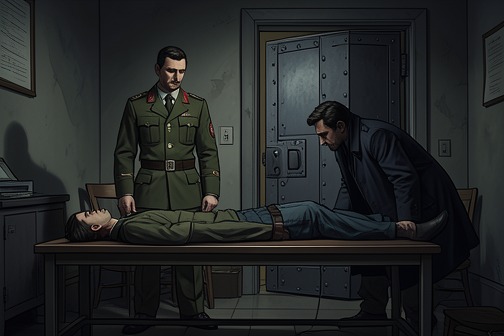
[Augustus Landor](entity:character-recall-character-augustus-landor-78f08974a4bb)’s appointment to investigate the Fry case begins as a request to find whoever took [Leroy Fry](entity:character-recall-character-leroy-fry-c643aeb3e4e0)’s heart, but Landor challenges the question embedded in that request. At Ward B-3, with Fry’s body still before him, he asks whether the [United States Military Academy at West Point](entity:location-recall-location-united-states-milita-bcc76c0a0476) wants him to discover who removed the heart or who hanged Fry. The distinction makes the appointment more than an assignment to solve a gruesome desecration: it raises the possibility that the apparent hanging itself was a murder disguised as suicide.
## Mandate and Institutional Stakes
[Sylvanus Thayer](entity:character-recall-character-sylvanus-thayer-e0a52d824c77) makes the appointment against the interests of his own career. He tells Landor that his career means little beside the Academy’s survival and that, if he could be sure it would endure, he would leave [West Point](entity:location-recall-location-west-point-82514378f844) the next day. The remark places the investigation within an institutional crisis: the death of a cadet and the violation of his body threaten not only the family or fellow students but the standing and future of the school.
Thayer describes Fry as having died young and by his own hand, then condemns the offense against his defenseless body as a crime against nature and an attack on the heart of the institution. He does not treat the possibility of an outsider and that of an insider as equivalent. If a passing fanatic is responsible, Thayer leaves the matter to God; if one of the Academy’s own is responsible, he vows not to rest until that person is removed from West Point. Whether the offender is sent away in irons or walks free, Thayer insists that he must leave on the next steam packet. His concern is both punitive and institutional: the investigation must identify the guilty person and help ensure that the crime does not happen again.
## Landor’s Decision
Landor does not answer Thayer’s offer at once. After asking whether Thayer truly believes him to be the right man and whether he is expected to follow the matter to its end, he says he will give his answer at six. The pause matters: the appointment is not presented as an automatic acceptance of a superior’s order, but as a charge Landor considers before taking it on.
At ten minutes to six, Landor tells Lieutenant Meadows that he is through. Five minutes later he is back in Ward B-3, where Thayer and [Ethan Allen Hitchcock](entity:character-recall-character-ethan-allen-hitchco-95c500f51bc3) stand beside Fry’s shrouded body. Landor is on the verge of declaring himself Thayer’s man, but instead asks which death the Academy wants him to investigate: the removal of Fry’s heart or the hanging that preceded it. He does not refuse the commission. He recasts its central problem, refusing to let the conspicuous mutilation settle the question of how Fry died.
## The Body as Evidence
Landor’s first examination gives practical force to that distinction. He rolls up his sleeves, plunges his hand into the alcohol bath, and hauls Fry’s head and body toward the surface. He points out that the rope did not leave a clean, fixed cinch: it had run up and down the neck, as though searching for a purchase. Landor reads that irregular mark as evidence that Fry fought against the rope, rather than treating the hanging as self-explanatory.
The examination also brings [Hitchcock](entity:character-recall-character-hitchcock-08b7f194a2d4) and a doctor into the evidentiary process. Hitchcock eventually rolls up his sleeves and helps handle the body. The doctor identifies a contusion on Fry’s skull, roughly a quarter of an inch above it. When Landor asks whether the bruise could have been inflicted after death, the doctor explains that bruising involves blood escaping from its vessels and is therefore unlikely once circulation has stopped. The exchange establishes that the commission will depend on distinguishing what the body actually shows from what the presumed suicide suggests.
## Scope and Consequences
The inquiry later applies the same distinction to [Randolph Ballinger](entity:character-recall-character-randolph-ballinger-1ea8069820e4)’s body. In discussing the two cadets, Landor elicits that Ballinger was found hanging higher than Fry, with his feet off the ground, and that his wounds were present when he was discovered. The account rules out the idea that he suffered those injuries afterward and then hanged himself; the apparent suicide is therefore void as a pretense. Yet the storm, mud, snow, and many soldiers’ footprints leave unresolved whether Ballinger came to the place willingly or was alive when he arrived. This later comparison shows the kind of case the appointment sets in motion: bodily evidence can overturn a staged appearance, while still leaving important questions unanswered.
Landor’s charge thus has two linked demands, stated by Thayer and sharpened by Landor’s response: discover who committed the offense against Fry, and determine what the offense actually was. By separating the taking of the heart from the hanging, the appointment gives the investigation its governing question and makes the body—not the first account of its death—the starting point.
Event 5
Recruitment of Edgar Allan Poe as Landor's informant
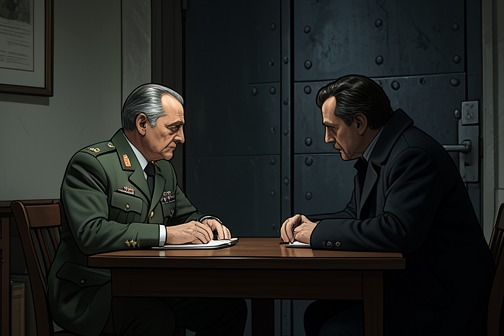
The recruitment of [Edgar Allan Poe](entity:character-recall-character-edgar-allan-poe-7cdacbfd7656) as Landor's informant turns a civilian investigator's exclusion from the cadet corps into a covert working arrangement with one of its own. [Augustus Landor](entity:character-recall-character-augustus-landor-78f08974a4bb) must persuade [Colonel Thayer](entity:character-recall-character-colonel-thayer-4874c3785bf4) and [Captain Hitchcock](entity:character-recall-character-captain-hitchcock-7b79a53dd1d3) to permit an unofficial assistant, then persuade Poe to accept a role that Landor describes as observation rather than informing. The resulting handshake begins their investigative partnership, but its very informality leaves the arrangement suspended between military discipline, secrecy, and personal trust.
## Causes and Background
Landor asks Colonel Thayer and Captain Hitchcock to let him engage one of their cadets as an assistant. He knows that the request crosses a boundary they have carefully maintained between military and civilian authority. Their response is immediate: the teacups go down, their heads snap up, and they begin setting out their objections. Landor sees that he is not asking for a routine favor but attempting to undo the separation that has governed his access to the academy.
He argues that his restrictions make ordinary investigation among the cadets ineffective. He cannot move freely among them or speak to them without permission, and even an investigator with greater access might not get far: young men, he says, are skilled at keeping secrets. In his account, the academy's system itself encourages that silence. Information, he argues, is most likely to emerge through someone who belongs to the cadet corps. His case thus makes the obstacle to his inquiry the reason to appoint a cadet as his agent.
Landor also offers practical assurances. The assistant will continue attending recitals and drills, fulfill all military duties, and maintain class standing; the intelligence work, he says, could count as valuable experience for a future career. Thayer and [Hitchcock](entity:character-recall-character-hitchcock-08b7f194a2d4) do not become enthusiastic, but they eventually discuss possible candidates. When Landor proposes Poe, their silence initially makes him think they do not know the name. He realizes that he has misread their pause: they recognize it.
## The Offer to Poe
Landor presents the position to Poe as an offer of employment, not an official appointment. He makes clear that it depends on satisfactory performance as a cadet and will end if Poe fails or falters in those duties. By invoking Colonel Thayer and Captain Hitchcock, he lets Poe know that his superiors are aware of the proposal. Landor reflects that even a plebe with large ambitions may feel beneath the notice of his superiors; discovering that they have noticed him can make him strive to deserve that attention.
To explain the work, Landor draws on his time as a constable in [New York City](entity:location-recall-location-7a11f2949ca3). His most useful news, he says, came not from newspapers but from people whom respectable society would shun: criminals and other marginal figures whose information was indispensable to police work. Poe understands the implication and names the position an informer's. Landor recasts it as an observer's role, saying that he wants Poe to be what Poe already is. That distinction does not remove the underlying secrecy; it gives the work a less compromising description and presents it as an extension of Poe's existing habits of attention.
The surviving exchange does not specify what particular subjects Poe is to observe. Landor instead insists on precision and brings the conversation to a decision: Poe must answer yes or no. The offer therefore combines a broad assignment with strict conditions. Poe is to gather information from within the cadet corps, while remaining subject to the same visible duties and standards as before.
## Acceptance and Arrangement
Poe rises for the first time in the conversation and goes to the window. Landor declines to claim knowledge of the feelings competing in him, but recognizes that the delay makes the eventual answer more intense. Poe finally agrees. With a lopsided smile, he says he would be perversely honored to be Landor's spy. Landor answers by calling himself Poe's spymaster, and the two shake hands by mutual consent.
The handshake is both an agreement and a small breach of the formality they have just observed. They pull their hands away as if they have already crossed a code. Landor then proposes that they meet on Sunday after chapel at [Cozzens' Hotel](entity:location-recall-location-cozzens-hotel-77b578fbe3b5), asking whether Poe can reach it without being seen. The detail gives the new arrangement its immediate method: their contact must remain private, even as Poe continues his public life and obligations as a cadet.
## Consequences and Retrospective Significance
The recruitment makes Poe an insider in an investigation whose central difficulty is the secrecy of the cadet community. Landor's case to his superiors depends on the claim that an outsider cannot readily penetrate that community; his offer to Poe turns this limitation into a partnership. The conditions attached to the job also preserve the academy's authority: the assignment is unofficial, and Poe's position as Landor's assistant cannot excuse any lapse in cadet duties.
The later recovery of two scraps of text complicates the trust implied by the recruitment. Landor tells Poe that one is the note found in [Leroy Fry](entity:character-recall-character-leroy-fry-c643aeb3e4e0)'s hand, which Landor had carelessly left with him; the other is a note Landor had left for Poe. He identifies the latter as a message written to ease his conscience, though he knew it could not be eased. This later disclosure does not alter the terms of the original conversation, but it casts a shadow backward over them: the investigator who recruited Poe as an observer had also left him evidence connected to Fry's death and a message burdened by Landor's own guilt. The handshake begins a working alliance, not a guarantee that Landor will be candid about everything Poe is asked to interpret.
Event 6
Discovery of the icehouse ritual site
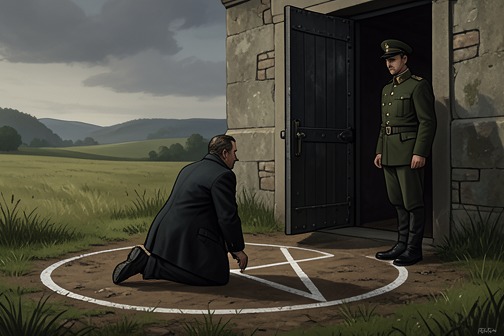
The discovery of the icehouse ritual site turns a difficult-to-see pattern of ground marks into evidence of deliberate ceremony. Working together, [Augustus Landor](entity:character-recall-character-augustus-landor-78f08974a4bb) and [Edgar Allan Poe](entity:character-recall-character-edgar-allan-poe-7cdacbfd7656) identify a circle and a triangle where [Leroy Fry](entity:character-recall-character-leroy-fry-c643aeb3e4e0)’s heart was removed; their reconstruction links the hidden traces to religious and occult imagery, and later events reveal that the pattern was not merely speculative. The investigation depends on a change in viewpoint: what had escaped a search at ground level becomes legible when the investigators look down and read the landscape as a record of objects that have been taken away.
## Background and Method
Landor brings Poe to the area north and slightly northeast of the [Icehouse](entity:location-recall-location-icehouse-d2530815eb05) door, which he identifies as the scene of the second crime: the removal of Leroy Fry’s heart. Its position seems chosen for concealment. Officers’ quarters lie northwest, the cadet barracks west, the academies south, and the guard post at [Fort Clinton](entity:location-recall-location-fort-clinton-dbc4a72c5a9a) east. Landor reasons that this location offered the perpetrator a chance to work unseen. Although he has already searched around the Icehouse, even crawling on his hands and knees, he has not found the clue. The breakthrough comes from abandoning that familiar vantage point.
The search begins with a request for Poe to look down from above and locate interruptions in the grass or soil, especially places where a rock or stick may have been driven into the ground. Poe spots a small indentation beside Landor’s left foot, perhaps three inches across. Landor presses one of the shiny white stones he collected by the river into the crevice, making the mark easier to see. They repeat this process, with Poe directing Landor to possible gaps and sometimes revising his judgments. Their work is halting: Poe takes several minutes to begin in earnest, and the whispered instructions make it difficult for Landor to follow them. The method nevertheless turns separate impressions into a visible arrangement.
## Reconstructing the Pattern
Landor’s religious hypothesis guides what the investigators look for. Leroy Fry had once associated with a disreputable group before joining the [Prayer Squad](entity:organization-recall-organization-prayer-squad-9b95174d0d56), and the condition of his body had made [Sylvanus Thayer](entity:character-recall-character-sylvanus-thayer-e0a52d824c77) think of a religious fanatic. Landor therefore considers whether the heart-removal might have been accompanied by a ceremony, with stones, candles, or other objects placed intentionally. Even if the objects were removed afterward, he reasons, their impressions might remain: the search party’s approach and the need to attend to the heart would have left little time to fill the holes. This is a theory about absent objects, not a direct observation of the ceremony, and the distinction matters to the investigation.
Using the white stones as markers, Landor scans the pale grass and plots their positions in a notebook. He moves in a wave pattern and measures the distances between the marks until the page holds a lattice of dots. Poe recognizes the outer design as a circle. Landor estimates it at ten feet in diameter, much larger than the space Fry’s body would occupy and large enough, in his vivid comparison, for several bodies. Looking again at the points within the circumference, the two men draw lines through the closest marks and recognize a triangle. Landor infers that Fry’s body had lain within it and begins to consider where the officiant might have stood, but the pattern alone does not establish who took part or precisely what happened.
A further clue comes from scorch marks that Poe recalls seeing from the roof. He shades a notebook page over the marks, bringing out what first looks like the reversed letters SHJ. When they consider that the whole message may have been reversed, Landor writes the letters out in ordinary orientation, and Poe identifies them as an inscription referring to Jesus Christ. Landor observes that the inscription was common in earlier times, though he had not seen it written backward. The discovery thus adds a Christian sign to the geometric traces, complicating any simple reading of the site as exclusively pagan or satanic.
## Interpretations and Textual Clues
Landor and Poe take their drawing to [Professor Pawpaw](entity:character-recall-character-professor-pawpaw-b46427fe492f) and ask what to make of it. Pawpaw gives the circle several possible meanings: an ancient Greek or alchemist might see an ouroboros and eternal unity, while a medieval thinker might understand it as creation and the void toward which creation tends. He is more decisive about the triangle within it, which he identifies as a magic circle. Drawing on Le Veritable Dragon Rouge, he describes a magician standing in the triangle, possibly with assistants, candles on either side, and a brazier in front. His account supplies a possible arrangement for the pattern, but remains an interpretation of a diagram rather than proof of the people’s actions at the Icehouse.
A passage Poe reads from de Lancre’s description of a witches’ sabbath gives the investigators a more disturbing textual association. The feast is said to include unclean animals, the hearts of unbaptized children, and the hearts of hanged men. Poe’s final item is especially suggestive because Fry had been hanged and his heart was removed. The passage intensifies the ritual hypothesis, but its force is associative: it connects a written account of occult practice to the physical facts of Fry’s death without, by itself, establishing the perpetrator’s motive or beliefs.
## Confirmation and Significance
The later approach to the Marquis family’s private ceremony gives the earlier reconstruction a startling visual counterpart. In a room lit by rows of wall tapers, a circle of torches encloses a triangle of candles; a fiercely burning brazier and a pine tree braced in the stone add to the display. An inscription is etched at the triangle’s base. Three figures move among the lights: a monk in a gray homespun robe, a priest in a cassock and surplice, and an officer of the [United States Army](entity:organization-recall-organization-united-states-ar-bc24e4a38db1) wearing what Landor recognizes as Joshua Marquis’s old uniform. This scene confirms that the circle-and-triangle arrangement belongs to an actual family ceremony, even though it does not make every earlier inference about the Icehouse self-evident.
The discovery is therefore both a piece of forensic reconstruction and a shift in how the crime can be understood. A set of small holes, first nearly invisible in the grass, becomes a map of ritual space; the reversed inscription and the texts consulted by Poe and Professor Pawpaw extend that map into religious symbolism. The contrast with the [United States Military Academy](entity:location-recall-location-united-states-milita-152206ae9d1f)’s public order sharpens the effect. During evening parade, the cadets’ companies absorb the missing place of Leroy Fry into their ranks, bridging the gap so that the formation appears whole. At the Icehouse, by contrast, the investigators find a second, concealed order marked in the ground. The ritual site makes the landscape preserve what the perpetrator tried to remove, while the later ceremony reveals how closely a family’s private performance echoes the pattern the investigators had painstakingly reconstructed.
Event 7
Poe identifies Artemus Marquis as a suspect
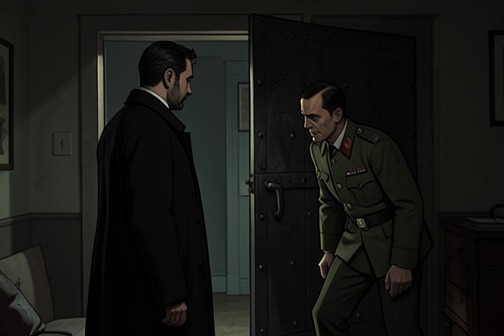
[Poe identifies Artemus Marquis as a suspect](entity:event-recall-event-poe-identifies-artemus-218a8ce61fb5) through a calculated approach to [West Point](entity:location-recall-location-west-point-82514378f844)’s [Prayer Squad](entity:organization-recall-organization-prayer-squad-9b95174d0d56): by pretending to seek religious guidance, he leads its members to name the cadet they associate with dark practices. The disclosure turns a general search for a secret Satanist enclave into an inquiry focused on a particular person, while leaving the central allegation unverified. The event’s importance lies as much in how the name emerges as in the name itself: Poe exploits the squad’s zeal, curiosity, and own reluctance to break its code of discretion.
## Background and Investigative Rationale
On the ride back to West Point, [Augustus Landor](entity:character-recall-character-augustus-landor-78f08974a4bb) and Poe remain silent until Poe speaks as he is dismounting about a quarter mile short of the guard post. Poe proposes that, if they want to locate a secret enclave of Satanists, they should turn to people most likely to notice such a group: its religious opposite. Landor identifies Christians, and Poe specifies the Prayer Squad rather than Reverend Zantzinger. The suggestion redirects their investigation from looking directly for suspected occult activity to asking a devout group what it fears or has heard.
The choice has a concrete connection to the case. [Leroy Fry](entity:character-recall-character-leroy-fry-c643aeb3e4e0) had briefly belonged to the Prayer Squad, a voluntary association of cadets dissatisfied with the Episcopal character of the West Point chapel and seeking a more direct path to God. Poe had previously held the group in contempt; now he argues that its members might be put to investigative use. The change is practical rather than a conversion of belief: the squad’s religious convictions, which had made it an object of Poe’s scorn, make it a useful source of information about the alleged enclave.
## Poe’s Approach to the Squad
Poe acts on Friday afternoon, after evening parade and before mess. He approaches Llewellyn Lee, a third classman and one of the squad’s leaders, asking to join the group at its next convocation rather than wait until Sunday chapel. Lee gathers several squad-mates for an impromptu discussion by the gun trestles. The setting and timing let Poe seek access through the group’s own members before a formal meeting, while his request presents him as someone in need of their counsel.
To secure their interest, Poe performs a version of himself quite unlike the religious skeptic he admits he is. He says he has recently encountered a fellow cadet who made dark, un-Christian overtures, challenged the grounds of his faith, and urged him toward mysterious practices of ancient origin. The story is a ruse, not an account of an actual conversion or encounter. Poe reports that he adopts a docile, deferential manner, inviting the cadets to respond as spiritual advisers while withholding the supposed offender’s identity.
## The Name Emerges
The squad members demand to know which cadet Poe means. He refuses, claiming that because the confidences were made privately, he is honor-bound to protect the name. When they press him again, he invokes the codes of an officer and a gentleman and says they could not force him to disclose it even under threat of divine punishment. The refusal is part of the bait: it makes the identity an object of curiosity while allowing Poe to appear steadfastly discreet.
The pressure eventually produces the answer Poe wants. One squad member, goaded beyond endurance, asks whether the cadet is Marquis. The others immediately silence the person who has spoken, pummeled him into silence; the group therefore yields a name but does not willingly elaborate. Poe later presents this as the result of his ruse and the squad members’ credulity. His account makes clear that they do not provide a confession or evidence of a particular act. Their spontaneous identification is the lead.
## What the Identification Establishes
When Landor asks whether the name means [Dr. Marquis](entity:character-recall-character-dr-marquis-a3db786b9ae0), Poe corrects him: he means [Artemus Marquis](entity:character-recall-character-artemus-marquis-56eabf3d652e), Dr. Marquis’s only son and a first classman. Poe adds that Artemus is reputed to dabble in black magic. That reputation explains why the cadets connect the name with Poe’s invented story, but it remains a report about Artemus, not proof that he practices magic or belongs to a Satanist enclave. The distinction matters: the investigation has narrowed, not solved, its question.
The episode also marks a shift in the inquiry’s method. Rather than confronting a suspected cadet directly, Poe draws information out of a group by staging a problem that touches its members’ deepest concerns and then refusing to satisfy their curiosity. Landor recognizes the tactic’s effectiveness, but the result is deliberately limited: the squad yields Artemus’s name, while its abrupt silencing of the speaker underscores how little more the investigators have secured. Suspicion now has a face, but verification remains ahead.
Event 8
Ballinger’s assault on Poe
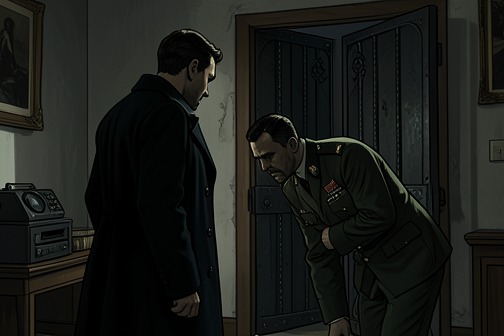
[Randolph Ballinger](entity:character-recall-character-randolph-ballinger-1ea8069820e4)’s assault on [Edgar Allan Poe](entity:character-recall-character-edgar-allan-poe-7cdacbfd7656) in [North Barracks](entity:location-recall-location-north-barracks-b3066f6ee083) converts an episode of uncertainty into a personal conflict: Poe is caught alone in darkness, attacked without warning, and then left to identify his assailant by voice. Recounted to [Augustus Landor](entity:character-recall-character-augustus-landor-78f08974a4bb) as part of Poe’s account of events around [Artemus Marquis](entity:character-recall-character-artemus-marquis-56eabf3d652e), the scene also exposes how little Poe knows at first about the danger facing him—and how quickly fear becomes anger.
## Narrative Frame and Context
Poe introduces the incident with a qualification: it bears only indirectly on Artemus Marquis, but he continues because he understands his charge from Augustus Landor to require a full account. This framing places Ballinger’s attack within a narrative that is not, at this point, primarily about Ballinger. The assault interrupts Poe’s account of his connection to Artemus and the invitation to meet Artemus’s sister; it is a consequence of Poe’s movements through the barracks, not an encounter he sets out to seek.
The narration is retrospective and addressed to Landor. Poe pauses to assess what belongs in the story, then reconstructs the episode through his own limited understanding at the time. The reader receives no independent explanation of Ballinger’s purpose. Instead, the scene proceeds from Poe’s perceptions—from the dark stairwell and his apprehension to the recognition that comes only after the attack. That restricted viewpoint makes the assailant’s identity a delayed revelation rather than an established fact from the outset.
## The Descent Through North Barracks
The immediate setting is the stairwell of North Barracks, which Poe describes as nearly impossible to see through. While feeling his way down, he catches his heel on a step and narrowly avoids tumbling by seizing a wall sconce. The near fall establishes his physical vulnerability before he reaches the ground level: he is already negotiating the space without reliable sight, and has no lantern with which to clarify what is around him.
At the door, Poe becomes convinced that someone is nearby, although he cannot identify anyone or explain why they would wish him harm. He reports hearing a low, quick sound and interpreting the darkness as evidence that he is being watched. His thought that he may be killed is presented as immediate fear, not as knowledge of a planned attack. The distinction matters: Poe’s senses and imagination register a threat before they can name its source, leaving him waiting in suspense rather than able to defend himself against a known opponent.
## Attack and Recognition
After a prolonged silence, Poe is suddenly seized. The surprise, he says, leaves him unable to begin an effective defense; he struggles until the assailant releases him, and he falls. The account does not establish how the assault began beyond that sudden restraint, nor does it provide a motive. Its defining circumstances are the isolated location, the darkness, and Poe’s inability to anticipate the physical encounter.
Only after the assailant has acted does Poe recognize him. A remark from above makes the speaker’s identity clear: it is Ballinger. The recognition resolves one uncertainty while leaving another intact. Poe can name the person who attacked him, but nothing in the episode explains why Ballinger chose to do so. The insult directed at Poe also makes the encounter humiliating as well as frightening, a distinction that shapes the response he describes afterward.
## Aftermath and Narrative Significance
Ballinger remains for a few seconds, breathing heavily, then goes back up the stairs. Poe is left deeply agitated and furious. He presents the encounter as an affront that cannot simply be excused in the pursuit of a larger cause, and imagines a future reversal in which hunter and prey exchange places. This is not an account of immediate retaliation: the assailant leaves, and Poe’s response is a stated expectation of eventual redress rather than a description of what he does next.
The scene’s movement is from uncertainty to recognition, and from fear to a language of vengeance. Darkness first prevents Poe from knowing who is present; the attacker’s voice then supplies the identification that sight could not. Poe’s decision to narrate the episode despite its indirect relevance to Artemus likewise matters to its presentation: it brings a personal injury into a larger account while acknowledging the digression. The result is a compact but consequential conflict, one in which Ballinger’s unexplained violence becomes, for Poe, a grievance and a promise that the existing balance of power will not remain unquestioned.
Event 9
Heart-and-bomb trap in Artemus Marquis’s quarters
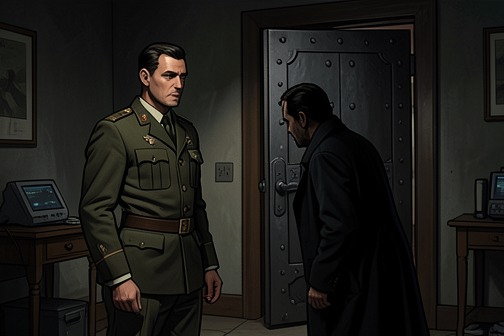
The trap in [Artemus Marquis](entity:character-recall-character-artemus-marquis-56eabf3d652e)’s [North Barracks](entity:location-recall-location-north-barracks-b3066f6ee083) quarters turns an ordinary search into a confinement, then into a test of what the evidence can and cannot establish. [Augustus Landor](entity:character-recall-character-augustus-landor-78f08974a4bb) and [Captain Hitchcock](entity:character-recall-character-captain-hitchcock-7b79a53dd1d3) escape a locked room as a lit shell burns outside its door; afterward they find a heart in a bundle in the woodbox. The shell proves harmless, and the heart is bovine rather than human. Together, the objects seem to implicate or protect Artemus, but their placement cannot be securely attributed to him. The scene advances the investigation by sharpening its central problem: evidence can be tangible and still fail to identify its maker or purpose.
## Search and Setting
North Barracks offers larger rooms than the cadets’ earlier quarters: Artemus’s measures twenty-five by nineteen feet. Its extra space does little to relieve its gloom. The west-facing room receives what light can clear the mountains, and even at midmorning the investigators need matches to inspect its tight corners. The furnishings and atmosphere provide no straightforward sign of recent revelry: patched pallets, hard-used coverlets, soot-streaked walls, scattered grains of snuff, but no cards, chickens, pipes, or lingering smell of tobacco. A compacted telescope, tucked between a water bucket and a chamber pot, is one of the objects they notice.
At Captain Hitchcock’s suggestion, they turn to the woodbox. Its contents initially seem mundane: wood, an old lottery ticket from Cuming’s Truly Lucky Offices, a scrap of book-muslin handkerchief, and a half-empty packet of Brazil sugar. The small finds make the search feel procedural, even faintly comic; Landor is nearly ready to pocket the sugar when a click sounds behind them. A second, fainter sound follows. As the sun begins to reflect off the western slopes, the light flooding the room lets Landor understand that the search has become something else. He tells Captain Hitchcock that they may have been expected, but the scene does not establish who prepared the room for their arrival.
## The Door and the Burning Shell
The door will not open. Captain Hitchcock first tries kicking it twice, then joins Landor in a series of blows that make a racket but do not loosen it. Through the noise, they hear a damp sputtering sound and see light flickering through the gap beneath the door. The narrow sounds and glimpse of flame turn the locked room into an immediate threat: they are not merely unable to leave; something burning is waiting on the other side.
Captain Hitchcock grabs a cadet trunk and hurls it at the door. The wood sags, but holds. On the next attempt, he and Landor throw their combined weight against it, forcing a gap of roughly three inches; another kick breaks the latch. In the hallway lies a black ball about the size of a cantaloupe, its long, yarn-like fuse still streaming with fire. Captain Hitchcock carries it to the nearest window, checks that no one is there, and throws it into the yard. The two men remain to watch the fuse burn down. Its eventual extinction brings neither explosion nor cloud of sulfur, only smoke and silence. The danger has been real enough to confine them and demand a hurried escape, but the expected blast never comes.
## The Bundle in the Woodbox
After the smoke clears and the shell still lies smoking in the grass, Captain Hitchcock returns to the woodbox and carefully unwraps the bundle he had dropped. Inside is a heart, described in Landor’s account as “Oozing rust. As raw as life.” Its appearance initially suggests a human organ, and the discovery carries the force of a new piece of evidence in an investigation already concerned with hearts being removed. Yet appearance is not identification.
A doctor compares the organ’s anatomy with a human heart and points to its size as decisive. This specimen, he estimates, weighs upwards of five pounds; a human heart seldom exceeds nine or ten ounces. He judges it almost certainly to be a cow’s, recalling his experience dissecting cow hearts in Edinburgh. Captain Hitchcock connects the identification to [Haverstraw](entity:location-recall-location-haverstraw-50e360f0ba65) and concludes that the heart must have come from there. The object therefore resembles incriminating evidence but does not prove that a human heart was hidden in Artemus’s quarters, much less that Artemus put it there.
## What the Evidence Leaves Unsettled
The heart and shell do not close the case. No one saw Artemus place the bundle in the woodbox, and cadet rooms are not locked, so another person could have left it there. The investigators also recognize that the piece of stovewood jammed into the door latch could have been put there by anyone seeking to keep them inside. The room’s apparent connection to Artemus is not proof of his control over its contents or access.
The shell is similarly inconclusive as evidence of a genuine attempt to kill. The powder magazine is lightly guarded, especially at night, and the shell has not been charged. Someone nevertheless lit its fuse while Landor and Captain Hitchcock were inside the quarters, between thirty and thirty-five minutes past ten. Landor interprets the uncharged bomb as a device intended to give Artemus an alibi: a threat outside his quarters while Artemus is at a recital could make it appear that someone else was trying to frame or endanger him. That is an inference, not a demonstrated fact. Captain Hitchcock sees the resulting contradiction plainly: one person may want to clear Artemus while another wants him hanged, and the evidence does not show where Artemus himself fits. The trap thus ends not in a resolution but in a tighter, more troubling ambiguity: the investigators have escaped, the shell has gone out, and the objects they recovered have multiplied the possible explanations.
Event 10
Cochrane’s account of the hospital body theft
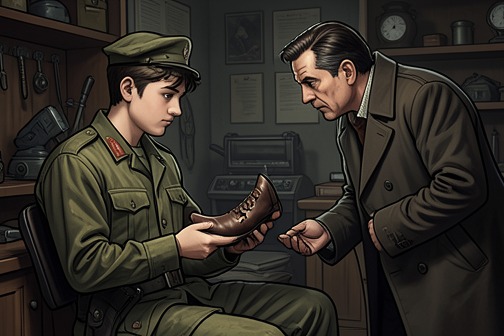
[Private Cochrane](entity:character-recall-character-private-cochrane-48a3087b4c8e)’s account of the hospital body theft turns a short absence from Ward B-3 into a carefully examined breach of the investigation. Under questioning by [Augustus Landor](entity:character-recall-character-augustus-landor-78f08974a4bb), Cochrane describes being sent away from the room where [Leroy Fry](entity:character-recall-character-leroy-fry-c643aeb3e4e0)’s body was guarded by an officer whose face he never saw. His testimony supplies a sequence, a discrepancy in his earlier statement, and several identifying details—but no name for the person who gave the order.
## The Interview and Its Setting
Landor interviews Private Cochrane in the shoemaker’s shop, where Cochrane has brought a right boot for repair, perhaps for the tenth time that year. The boot’s separated toe and sole form a conspicuous gap; Landor describes it as seeming to speak when Cochrane speaks and fall silent when he does. The image makes the boot the most expressive feature in an otherwise restrained portrait, while the setting gives the questioning an ordinary, workaday frame rather than the formality of a military hearing.
Cochrane is a slight, bent young soldier, with downcast eyes and a face Landor reads as boyish and difficult to interpret. Landor does not begin by accusing him of misconduct. He says he has found a problem in the statements and affidavits relating to the night of [October 25](entity:time-recall-time-october-25-1396a20c61b6) and asks Cochrane to walk through what happened. The method is incremental: first the duty, then the relief from it, then the identity and instructions of the person who took his place. Cochrane’s jaw tightens when Landor introduces the conflicting statement; later, sweat at his hairline and his bowed head register the pressure of being asked to account for the gap.
## The Diversion from Ward B-3
Cochrane confirms that he had been assigned to Ward B-3 after Fry’s body was brought back to the hospital. He says he was relieved at about two-thirty in the morning. That detail becomes important because, in an earlier statement taken shortly after the body disappeared, he had named Lieutenant Kinsley as the person who relieved him. When Landor raises the discrepancy, Cochrane acknowledges the earlier version but ultimately says he cannot give the officer’s name because he never learned it.
The unnamed officer did not simply dismiss him. He told Cochrane to report to Lieutenant Meadows’s quarters. Cochrane says he went there at once; the journey took no more than five minutes, but Meadows was still asleep and said he had not sent for him. Cochrane then returned to the hospital to make certain of his orders. On reaching Ward B-3, he found the room empty of the body. He estimates that he had been away for no more than half an hour. The sequence makes the false errand consequential: it removed the guard from the ward and sent him to a destination where no one was expecting him.
After finding the body gone, Cochrane ran straight to the guardroom in [North Barracks](entity:location-recall-location-north-barracks-b3066f6ee083), reported what had happened to the officer on duty, and that officer informed [Captain Hitchcock](entity:character-recall-character-captain-hitchcock-7b79a53dd1d3). His account therefore distinguishes the moment of discovery from the later reporting of it. The body’s absence was not something he concealed once he returned; the unresolved issue is how the order that created the unattended interval was given and by whom.
## What Cochrane Saw—and Could Not See
Cochrane never saw the officer’s face. The candle was held so that he could see a bar on the man’s shoulder, which led him to take him for an officer. The bar was thus the basis for accepting the stranger’s authority, not proof of his identity. Cochrane says the man did not otherwise identify himself. The apparently official appearance of the order and the absence of a name are central to the account: the instruction could command obedience while leaving the person who issued it difficult to trace.
Landor asks about the officer’s voice and build. Cochrane remembers a voice in the medium-to-high range and estimates that the man was two or three inches shorter than Landor. He doubts he could recognize the officer by sight, but allows that he might recognize the voice if given the chance to hear it again. These recollections offer possible lines of inquiry without resolving the identification. They are also markedly less precise than the timeline: Cochrane can describe the errand and its duration more confidently than he can describe the person who sent him.
## Evidentiary Significance and Limits
The account establishes a practical opportunity for the body’s removal: during Cochrane’s absence, the hospital ward was no longer under his watch. It also revises the record. The initial naming of Lieutenant Kinsley cannot stand alongside Cochrane’s later insistence that he never knew the relieving officer’s name. His explanation does not identify who supplied the false impression or why Kinsley was named, so the discrepancy remains a reason to scrutinize the testimony rather than a complete solution to it.
The interview carefully separates observable details from conclusions. Cochrane can attest that an officer-like figure used a candle to show a shoulder bar, directed him to Meadows’s quarters, and left before Cochrane returned to find the body missing. He cannot attest to the figure’s face, actual rank, or identity. His possible recognition of the voice is only a possibility, not a recognition already made. The narration’s return to the boot, the pause over the earlier statement, and the progressively narrower questions give the testimony the shape of a small investigation inside the larger one: an absence is reconstructed, but the person responsible remains outside the frame.
Event 11
Leroy Fry’s funeral and diary handoff
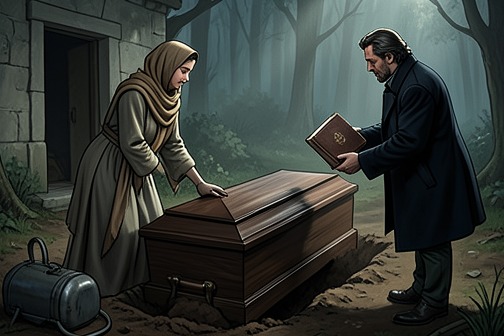
[Leroy Fry](entity:character-recall-character-leroy-fry-c643aeb3e4e0)’s funeral and the handoff of his diary join the public rituals of burial to the private work of investigation. On a foggy November morning, the sealed coffin is lowered into the ground at [West Point Cemetery](entity:location-recall-location-west-point-cemetery-cc37b7866faf); afterward, Fry’s mother entrusts his hidden, ciphered diary to [Augustus Landor](entity:character-recall-character-augustus-landor-78f08974a4bb), giving the inquiry a new written trace of the dead cadet’s life.
## Burial and Its Forensic Background
The funeral takes place on the day Fry’s body is committed to the earth. His coffin remains closed from the moment six bombardiers lift it from the hearse until the ground closes over it, so the ceremony offers no further inspection of the body. That limitation matters in an investigation already shaped by physical evidence: earlier, Landor had plunged his hand into the alcohol bath at the Academy hospital and hauled Fry’s corpse toward the surface. He observed that the rope had not made a clean, even mark around the neck; it had run up and down, as if searching for a hold. [Dr. Marquis](entity:character-recall-character-dr-marquis-a3db786b9ae0) also identified a contusion rising about a quarter inch above the skull. He explained that bruising depends on blood escaping from its vessels and would not ordinarily form after death, when circulation had ceased. These observations do not themselves settle the circumstances of Fry’s death, but they make the closed coffin a stark boundary between what the investigators had seen and what the mourners could see.
Fry’s body had remained at the Academy hospital, where Dr. Marquis began injecting it with potassium nitrate as a preservative. Landor recalls the corpse growing greener and the ward filling with the smell of spoiled meat, with flies gathering around it. That deterioration stands in sharp contrast to the formal dignity of the funeral: the body is borne beneath banners and black plumes, but its condition has already made it an object of medical examination as well as grief.
## The Funeral at West Point Cemetery
Landor remembers the cemetery as an especially fitting burial place, and the November morning makes the scene vivid without making it consoling. Fog rolls around the mourners’ shins; wind moves through stones and brambles; the year’s last leaves gather in scarlet drifts around white crosses. The muffled drum accompanies the procession. The bier creaks beneath the coffin’s weight, and the lowering cord grates as it descends. Then the dirt clods strike the stark pine box, a sound Landor remembers as seeming to rise through the ground.
Fry’s mother is the mourner Landor can recall most distinctly. Stooped and dressed in black crepe, she has a freckled face and a drawn frame, with cheeks that remain conspicuously plump and pink. She coughs out small breaths and rubs at tears that are not there, leaving red marks beside her nose. Landor cannot remember Fry’s father, and much of the rest of the ceremony has blurred in his memory. Reverend Zantzinger’s sermon becomes, in retrospect, a long procession of shouting dragoons and thundering hooves. The bombardiers fire volleys over the grave; the mountains return the reports until the echoes seem to accumulate rather than fade. Landor also experiences the departure of the hearse and the chaplain’s movements as unnaturally slow, as if the funeral’s duration had stretched around the act of burial.
## The Diary Passes to Landor
After the burial, Fry’s mother approaches Landor. Words of condolence fail him, and he is relieved when she stops trying to speak and searches her reticule instead. She presses a small, clothbound volume with gilt edges into his hand: [Leroy Fry’s diary](entity:object-recall-object-leroy-fry-s-diary-e3d87ecd6c34). She believes it goes back at least three years. Landor is surprised because he does not recall a diary among the personal effects reported to him.
[Mrs. Fry](entity:character-recall-character-4196630b2257) explains that [Randolph Ballinger](entity:character-recall-character-randolph-ballinger-1ea8069820e4) gave it to her. According to her account, after hearing what had happened to Fry, Ballinger went directly to Fry’s quarters, found the diary, and believed that no one but Fry’s mother should read it. He returned it to her with the option of burning it. She now reconsiders that choice: because Landor is investigating the case and the Army is depending on him, she decides he should have the book. Her gesture makes the funeral more than a closing ceremony. A possession recovered by Ballinger and kept by Fry’s mother moves into the investigator’s hands, carrying the possibility of evidence with it.
The diary is difficult to read by design. Fry had crosshatched its entries, drawing vertical columns across horizontal ones so that the writing became a jumble capable of frustrating a prying reader—and perhaps even its author when trying to transcribe it. Mrs. Fry cannot make sense of the marks. Landor recognizes that the obscurity is intentional and that reading it requires a trained eye; his attention has already begun sorting the patterns while she is still beside him. Her final appeal is that Fry’s killer should be caught. The book thus passes from a mother who cannot decipher it to an investigator who can attempt to do so, turning private grief into a new line of inquiry.
## Consequence and Narrative Significance
The event brings together two kinds of testimony that do not carry the same certainty. The body had offered marks to observe and medical explanations to weigh; the diary offers words whose arrangement must first be deciphered. The evidence has also passed through several hands: Fry wrote the entries, Ballinger found the volume and gave it to Fry’s mother, and she transferred it to Landor. That chain of custody gives the handoff importance while leaving the diary’s contents and interpretation to the work that follows.
Landor’s account frames the burial through the sensory persistence of sound—the creaking bier, the cord, the dirt, and the volleys echoing in the mountains—while the diary introduces a different kind of lingering trace. Fry is physically committed to the earth, but his concealed record remains active in the investigation. The funeral therefore marks both an ending and a transition: the body disappears from view behind the coffin and the grave, while a coded account of the dead cadet’s life begins to speak through the hands of those left behind.
Event 12
Lea Marquis’s seizure at the West Point cemetery
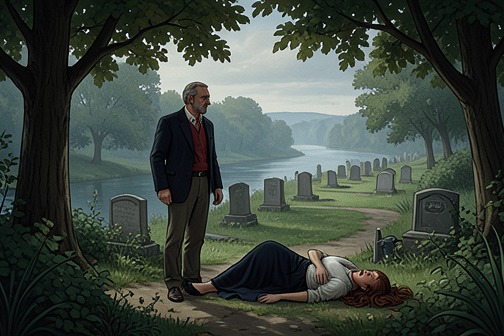
[Lea Marquis](entity:character-recall-character-lea-marquis-cfc853823821)’s seizure at [West Point Cemetery](entity:location-recall-location-west-point-cemetery-cc37b7866faf) interrupts [Edgar Allan Poe](entity:character-recall-character-edgar-allan-poe-7cdacbfd7656)’s vigil for her with a sudden disappearance and a frightening collapse. In Poe’s account to [Augustus Landor](entity:character-recall-character-augustus-landor-78f08974a4bb), anticipation gives way to fear, then to the discovery that [Lea](entity:character-recall-character-e02381c64c00) is alive but incapacitated. The episode makes her vulnerability immediate while keeping the cause of her terror unresolved: Poe can describe what he witnesses, but he cannot identify what she perceived or explain all that has happened to her.
## Setting and the vigil
Poe places the encounter in a cemetery about half a mile from the [United States Military Academy](entity:location-recall-location-united-states-milita-152206ae9d1f), on a high bank above the [Hudson River](entity:location-recall-location-hudson-river-4104d5ad1140). Trees and shrubbery partly conceal the small enclosure, while its shaded walk and views toward the Academy and surrounding highlands lend it a quiet, secluded character. For Poe, that setting is both a place of the dead and the scene of an intensely present concern: his thoughts are fixed on a woman who is still alive.
Lea’s expected arrival occupies Poe’s attention before she appears. He describes her imminent visit as having exhausted his powers of concentration, and he waits past the appointed hour rather than abandon the vigil. His watch marks thirty-two minutes after four when he hears silk moving and sees her pale yellow bonnet. The measured delay gives way to a private meeting in a setting where ordinary duties and the surrounding landscape recede behind his attention to Lea.
## Terror and disappearance
After Lea arrives, her mood shifts. She eventually acknowledges that she has been behaving strangely, but Poe cannot determine what lies behind her distress. When he notices her shivering, he offers his cloak; she does not answer, and her fear intensifies. Poe’s narration emphasizes the limits of his knowledge: he reads terror in her expression and becomes afraid himself, but the threatening presence he imagines cannot be found.
Poe searches around the monument, inspecting the nearby stones and trees and circling the area. Finding no one, he turns back to discover that Lea has disappeared from the place where she had been standing. His concern for her overtakes thoughts of evening parade and military duty. He searches the shaded walk and nearby ground, calling out and even looking over the cemetery bluff, afraid that she may have fallen. The moment reverses the scene’s earlier arrangement: Poe had waited for Lea to arrive, but now he cannot find her and fears that he may be too late to help her.
## Discovery and recovery
Poe finds Lea less than fifty yards from where he last saw her, lying on hard, rocky ground beyond a rhododendron bush. She is pale and unresponsive, with her eyes turned upward and her body trembling. These observations lead Poe to fear for her life, but he does not treat them as an explanation of what caused the episode. He remains beside her, waiting for the fit to pass and watching for signs that she is breathing and regaining awareness.
The change is gradual. After a period in which neither of them speaks, Poe notices her breathing and small movements that assure him she is alive. The relief does not erase the seriousness of what he has witnessed. Her appearance is disordered, and there are signs that she has also been physically harmed. Poe registers this distinction without establishing who or what was responsible; the account conveys both the seizure and a possible human threat, but does not resolve their relationship.
When Lea can speak, she apologizes for troubling Poe and asks him to walk her home, adding that her mother worries when she is away too long. The request brings the scene back to ordinary obligations and family life, but it does not make the encounter ordinary. Poe has seen her pass from agitation into apparent unconsciousness and then return to awareness, while the cause of her fear and the harm to her remain uncertain.
## Narrative significance
The event is presented through Poe’s first-person recollection, shaped by his intense attachment to Lea. His account makes the cemetery’s stillness heighten the contrast between the expected meeting and the sudden emergency, while his escalating search shows how quickly concern becomes fear. Because the scene is confined to what Poe observes and feels, it offers no independent confirmation of the presence he suspects. His terror is real as an experience, but its object remains unknown.
The episode also belongs to a broader narrative in which bereavement and memory continue to shape the living. Elsewhere, Augustus Landor describes how the absence of [Amelia](entity:character-recall-character-amelia-d47b5f584b5b) and the loss of his daughter persist in the intimate space of his bed; later, he reflects on time as bringing the living and dead into continuing relation. Against that frame, the cemetery scene places Poe’s intense attention on Lea, not on the dead around them. The event’s decisive movement is from anxious waiting to a search for a living person in danger, and then to a fragile relief when she survives. It establishes Lea’s vulnerability and Poe’s devotion without supplying a complete account of either her illness or the source of her terror.
Event 13
Richmond theater fire of 1811
The [Richmond theater fire of 1811](entity:event-recall-event-richmond-theater-fire-o-025b0b9f03d4) enters the narrative through [Edgar Allan Poe](entity:character-recall-character-edgar-allan-poe-7cdacbfd7656)’s account of his parents’ deaths: he says they died in the fire and identifies them as renowned actors. The book gives no further details of the blaze, keeping its significance here personal and biographical rather than reconstructing the disaster itself.
## The Event in Poe’s Account
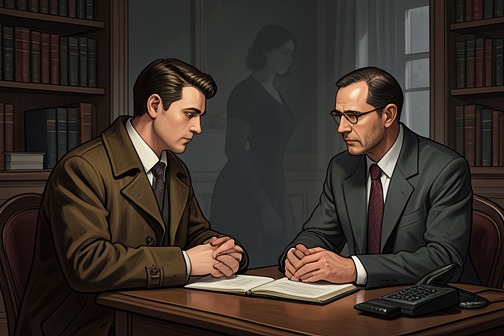
During a conversation with [Professor Pawpaw](entity:character-recall-character-professor-pawpaw-b46427fe492f), Poe is called an orphan. He quietly confirms that this is true and specifies that his real parents died in the Richmond theater fire of 1811. Asked about their reason for being at the theater, he explains that they were actors, remembered as very fine and renowned.
## Narrative Significance
The reference establishes the fire as the cause of Poe’s orphanhood and links his family history to the stage. These details come through Poe’s brief response under questioning; the passage supplies no names for his parents and no account of how the fire unfolded or how they died beyond identifying the fire as the cause.
Event 14
Leroy Fry murder case
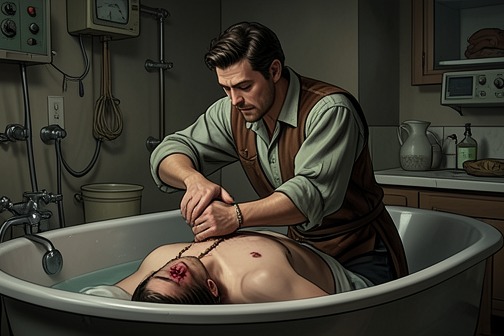
The [Leroy Fry murder case](entity:event-recall-event-185cc5939834) is presented through the close examination of Fry’s body, where the marks of death resist a simple explanation. [Augustus Landor](entity:character-recall-character-augustus-landor-78f08974a4bb)’s observations of the neck and head establish the physical clues that shape the inquiry, while a later comparison with [Randolph Ballinger](entity:character-recall-character-randolph-ballinger-1ea8069820e4)’s body returns the investigation to the question of what the evidence can—and cannot—prove.
## Examination of Fry’s Body
Landor retrieved Fry’s body from an alcohol bath, lifting it with both hands to keep it from sinking. He focused first on the neck: the rope mark did not form a clean, even cincture but ran unevenly along it, as though the rope had shifted while seeking a hold. The detail made the mark itself significant, without by itself establishing exactly how or when it had been made.
The examination also identified a contusion on Fry’s head. When Landor asked what might have caused the lump, the doctor could offer only a general explanation: a hard object had contacted the head. Without examining it further, he could not say more. The exchange distinguishes an observed injury from a conclusion about its cause.
## Evidence and Its Limits
The neck mark and head contusion give the inquiry concrete points of reference, but the available examination does not resolve every question. Landor’s attention to the rope’s uneven course suggests that the body did not present the simple, conclusive sign of a cleanly tightened noose. The doctor’s uncertainty about the contusion likewise leaves its precise origin undetermined.
This restraint matters to the case’s reasoning: bodily evidence can challenge an initial account of death while still leaving gaps in its reconstruction. The examination supplies observations to be weighed, not a complete account of the circumstances.
## Later Comparison with Ballinger
When Landor later asked [Edgar Allan Poe](entity:character-recall-character-edgar-allan-poe-7cdacbfd7656) what distinguished Randolph Ballinger’s body from Fry’s, Poe struggled at first to answer, then recalled that Ballinger had been suspended much higher than Fry. He reasoned that injuries of that severity could not have been sustained before a person then climbed and hanged himself; in his view, the proposed suicide was therefore untenable. This is Poe’s inference about Ballinger’s death, not a finding about Fry’s case, but the comparison places Fry’s body within the investigation’s developing forensic frame.
Landor also described the condition of Ballinger’s body when he had last seen it in the [West Point hospital](entity:location-recall-location-west-point-hospital-15760190d8ec): the ice storm had slowed its decay, and the skin retained a slight blue flush. He contrasted its more imposing appearance with Fry’s body, while noting that Ballinger’s neck mark was deeper and the damage to the chest more jagged. The comparison makes the two deaths legible through differences in physical condition, without erasing the distinct evidence attached to each.
## Investigative Significance
Fry’s case is defined here less by a final verdict than by the movement from an apparent hanging toward closer scrutiny of the body. The uneven neck mark, the unexplained head contusion, and the later return to Fry as a comparison point show how the inquiry proceeds through observation and qualified inference. Each detail narrows what can be assumed, while the limits of the examination leave the larger reconstruction open.
Event 15
Randolph Ballinger murder case
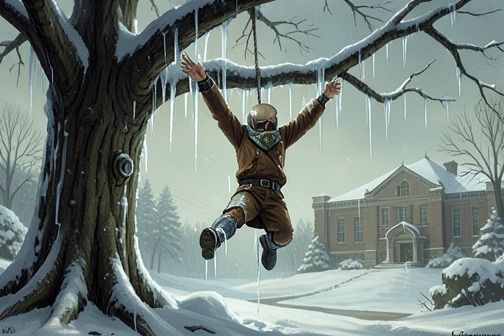
The [Randolph Ballinger murder case](entity:event-recall-event-aea5a005e05b) begins with an absence and turns on the interpretation of a body: Cadet First Classman [Randolph Ballinger](entity:character-recall-character-randolph-ballinger-1ea8069820e4) fails to return from guard duty, then is found after a storm, suspended in a birch tree. The investigation rejects suicide not through a confession or an eyewitness, but by distinguishing the order of events written on the body. Its comparison with the earlier examination of [Leroy Fry](entity:character-recall-character-leroy-fry-c643aeb3e4e0) makes forensic observation a recurring method in [Augustus Landor](entity:character-recall-character-augustus-landor-78f08974a4bb)’s inquiry, while the apparent hanging becomes evidence of a killing staged after the injuries had already been inflicted.
## Disappearance and Discovery
On Wednesday morning, Ballinger does not return from his guard posting. The search resumes as soon as the storm abates, but the thaw comes almost as quickly as the freeze. Shortly after four o’clock, two privates are returning to the commandant’s quarters with their report when a nearby birch shakes off its coating of rime. The movement reveals Ballinger’s body, huddled among the branches. The sudden change in weather makes the discovery possible: what had been concealed in the tree becomes visible as the ice falls away.
The circumstances of the discovery are more than a dramatic setting. Ballinger is found higher in the tree than Fry had been, a difference Landor notes when he looks up into the branches. The body’s position invites comparison with the earlier case, but the investigation does not treat resemblance as proof that the two deaths occurred in the same way. Instead, height and placement become questions to test against the wounds and the mechanics of suspension.
## Findings on Ballinger’s Body
At first, Landor asks whether Ballinger had been hanged. The account then discloses a further assault: Ballinger had been castrated. This is not presented as an incidental detail. It makes clear that the body bears signs of violence beyond the hanging and sharpens the need to establish when each injury occurred. The evidence is described without supplying a motive or identifying the person responsible at this point in the investigation.
Landor’s decisive distinction concerns sequence. Unlike the possibility of subterfuge raised by the earlier case, Ballinger is found with all his wounds on him. Landor concludes that Ballinger was killed, cut open, and only afterward strung up. The order matters: a person already bearing those injuries could not have climbed to that height and hanged himself. On that physical reasoning, the appearance of suicide is untenable. The finding does not depend simply on the presence of a rope or a body in a tree; it depends on recognizing that the injuries preceded the suspension.
## Comparison with the Fry Examination
The investigation’s attention to sequence has a precedent in Landor’s examination of Leroy Fry. To bring Fry’s body toward the surface of an alcohol bath, Landor rolls up his sleeves and reaches in, then supports the body with both hands. He focuses first on the neck, where the rope has not left a simple, even cinch: its mark runs up and down as though it had shifted while seeking a hold. That observation directs attention away from the assumption that the visible hanging tells the whole story.
The earlier examination also records a contusion on Fry’s head. Asked what might have caused the lump, the doctor explains that a hard object striking the head could account for it, while declining to say more without examining it. The exchange establishes a limit as well as a clue: an observed mark can support a possible explanation, but the mark alone does not establish precisely how it was made. Against that cautious standard, Landor’s assessment of Ballinger rests on the stronger conclusion that the wounds were already present when the body was found hanging.
## Significance to the Investigation
The Ballinger case renews the investigation’s reliance on bodily evidence. Landor compares the height at which Ballinger was found with Fry’s case, distinguishes what the bodies share from what differs, and uses the timing of the wounds to reject the staged appearance of self-inflicted death. The storm and the tree explain how Ballinger is discovered; the marks on his body explain why the discovery cannot be read as suicide.
The scene therefore shifts the inquiry from a missing cadet and an apparent hanging to a confirmed killing followed by concealment of its true sequence. It also shows the limits and force of forensic reasoning in the narrative: the doctor’s qualified interpretation of Fry’s head injury remains a possibility, whereas Landor’s conclusion about Ballinger follows from the incompatibility between his condition and the supposed act of hanging himself. The body does not name its killer, but it decisively changes the meaning of how Ballinger was found.
Event 16
Landor is attacked outside Benny Havens’s tavern
Landor is attacked outside [Benny Havens' tavern](entity:location-recall-location-benny-havens-tavern-8d9d7828d213) when a customary warning of a military raid gives way to a nighttime pursuit. He catches sight of a fleeing figure near a horse, but a second assailant intervenes and knocks him unconscious. The encounter ends in failure as a physical chase, yet Landor recovers a white priest’s collar from the struggle—a concrete clue that complicates the apparent escape and resonates with his investigation of religious ritual.
## Background and the tavern drill
The incident begins inside Benny Havens' tavern, where a visit from one of [Sylvanus Thayer](entity:character-recall-character-sylvanus-thayer-e0a52d824c77)’s officers is a familiar weekly occurrence. On a raid night, the person nearest the door gives the alarm; cadets who have chosen to run are hurried out and directed up the riverbank. The others stay behind, ready to feign ignorance if the officer asks whether cadets were present. The procedure is orderly and practiced, an informal arrangement shaped around evading the academy’s rules rather than confronting the officer.
On this night, [Patsy](entity:character-recall-character-patsy-874a2ba4262b) throws [Edgar Allan Poe](entity:character-recall-character-edgar-allan-poe-7cdacbfd7656) his cloak and helps him up, while [Benny Havens](entity:character-recall-character-benny-havens-59cb6ba63e57) pulls him away from the fireplace and toward the door; Mrs. Havens gives him a final push outside. The rapid response initially makes the episode look like another familiar escape. But the expected officer does not come through the door. Benny eventually opens it himself, and the gathering waits without knowing whether Poe has been stopped on the way to the river.
Asher Lippard, who sounded the alarm, insists that he recognized the insignia bar on an officer’s shoulder by lantern light. When Landor asks whether he saw anything else, Asher’s confidence falters: he had seen the bar, but could offer no further identifying detail. The distinction matters. The alarm has set the drill in motion, but the group has little reliable knowledge of who, if anyone, is outside. A routine signal has created both a distraction and an uncertain trail.
## The pursuit and attack
A fine icy rain falls outside, the same weather that had accompanied [Randolph Ballinger](entity:character-recall-character-randolph-ballinger-1ea8069820e4)’s murder. Landor goes up the steps toward the main road and hears movement that he takes to be a person running away. His response comes from his years as a constable: rather than remain at the tavern or wait for a clearer account, he follows. In the darkness, he cannot see the figure plainly and has to use the sound of boots to track it.
A horse nearby changes the stakes. Landor reasons that once the fugitive mounts, pursuit will become much harder, so he waits for the vulnerable moment of mounting before making his move. His eyes have adjusted enough for him to distinguish the horse and a second figure bracing against the saddle. He lunges at the most visible feature, a white stripe, and holds on as the two tumble down a steep part of the road.
The fall ends the immediate struggle but not in Landor’s favor. He loses consciousness, and when he comes to, the horse is already galloping north. At first he understands the failure as a mistake in his own calculation: he had assumed he was dealing with one fugitive. The encounter has in fact involved another person, hidden from his view and able to strike him while he grappled with the rider. The escape is therefore not simply the result of the horse or the darkness; Landor has been outnumbered.
## The recovered clue
After staggering back to the tavern, Landor has his head attended to by Mrs. Havens and receives the sympathy of the people inside. Only later does he notice what the struggle has left wrapped around his coat sleeve: a band of stiff white cloth, dirtied by the encounter. It is the white collar of a priest, the only object he has taken from the scene. The clue does not establish the identity of either assailant, but it gives material form to what would otherwise have remained an unexplained escape and assault.
The collar is especially suggestive in the context of Landor and Poe’s inquiry. At the icehouse, Landor had proposed treating [Leroy Fry](entity:character-recall-character-leroy-fry-c643aeb3e4e0)’s heart removal as an act with religious dimensions and looking for traces of a ceremony in the objects or impressions left behind. His method depends on remnants: even when the objects of a rite are removed, their marks may persist. Here, too, a person vanishes into darkness while a fragment of clothing remains. The collar cannot by itself prove a connection to the icehouse or to Fry’s death, but its religious association gives the pursuit an investigative consequence beyond Landor’s personal defeat.
## Consequences and narrative significance
The attack reverses the tavern episode’s ordinary logic. The weekly raid custom is designed to help cadets evade authority, and the group initially responds by performing its familiar roles. Yet the uncertain sighting, the absent officer, and the figure outside shift the night from a controlled drill into a pursuit with real danger. Landor’s constable’s instinct sends him away from the company and into a situation where darkness limits what he can identify and a second assailant can act unseen.
The narrative makes the outcome double-edged: Landor fails to catch the rider, but the assailants do not leave him empty-handed. The collar is a modest, ambiguous object rather than a solved identity, and its uncertainty is precisely what keeps the event open to further investigation. The assault also connects the investigation’s recurring concerns—concealment, religious signs, and evidence left behind—to Landor’s own exposure to violence. The attack does not resolve who pursued him or why; it converts an inconclusive chase into a new question for the case.
The incident is narrated by Landor as part of the main action. His account emphasizes the limits of what he could see and know at each stage: a reported insignia, boots on the road, a horse, a white stripe, and finally the collar. The sequence narrows attention from an unreliable alarm to a single recovered object. What first seems like another routine escape from a raid becomes a serious assault, and what seems like total failure yields the one clue that survives the darkness.
Event 17
Julius Stoddard’s disappearance and flight
[Julius Stoddard’s disappearance and flight](entity:event-recall-event-julius-stoddard-s-disap-644d6c1c4e78) turn an apparent echo of [Leroy Fry](entity:character-recall-character-leroy-fry-c643aeb3e4e0)’s death into a documented escape from [West Point](entity:location-recall-location-west-point-82514378f844). First announced as a possible second victim, Stoddard is later traced from his quarters to a fisherman’s boat and onward to a steamer bound for [New York City](entity:location-recall-location-7a11f2949ca3). The account supplies a route and a change of clothing, but leaves his urgency unexplained: he claimed there was a crisis at home, offered no details, and departed without a farewell.
## Alarm and Suspicion
The disappearance is reported while [Augustus Landor](entity:character-recall-character-augustus-landor-78f08974a4bb) is with [Captain Hitchcock](entity:character-recall-character-captain-hitchcock-7b79a53dd1d3), who says that another cadet has vanished. The news carries immediate weight because the recent investigation has made disappearance itself ominous. When Captain Hitchcock identifies the missing cadet as Stoddard, he emphasizes that Stoddard was the last cadet to see Leroy Fry alive and raises the possibility that he, too, has met the same fate. The link is circumstantial, but in the charged atmosphere of the investigation it makes a missing person sound like another murder victim.
The report also produces an unusual change in Captain Hitchcock’s conduct. He gives the news in Poe’s hearing rather than dismissing him, setting aside the strict decorum that ordinarily governs his dealings. Landor’s attention is fixed on the significance of that breach, even as the announcement itself unsettles those present. The episode’s first interpretation is therefore shaped not by evidence of violence, but by the fear generated by Fry’s case and by the identity of the last person known to have seen him alive.
## The Empty Trunk
Landor counters the assumption of a second death with a small, concrete discovery. He tells Captain Hitchcock that he has just visited Stoddard’s quarters and found the trunk empty. It contains no clothes, including no civilian clothes. The detail does not establish where Stoddard has gone, but it weakens the picture of a cadet who has simply vanished into violence: there is no change of attire waiting in his room, and no immediate sign there of an ordinary departure prepared in advance.
The empty trunk becomes legible only when the later account supplies the missing stages of the journey. Stoddard did not leave the Academy already dressed as a civilian. He was still wearing his uniform when he sought passage downriver, and changed only after he and his boatman had reached the river landing at Peekskill. What first looked like an absence of civilian clothing at West Point is thus consistent with a departure in which the uniform served as his appearance during the initial escape, before he changed into less conspicuous clothes farther from the Academy.
## Pike’s Account
The next morning, a local fisherman named Ambrose Pike comes forward with a detailed account. A young cadet had flagged him down and offered him a dollar to row him downriver. Pike took the young man as far as Peekskill. There, Stoddard drew another couple of dollars from a leather pouch and booked passage on the next steamer to New York City. The sequence establishes more than a direction of travel: it traces a transfer from a small boat to scheduled river transport, with Stoddard paying separately for each leg.
Pike’s testimony also resolves how a fugitive could travel without immediately appearing to be one. During the boat journey he remained in uniform, which is how Pike knew he was transporting a cadet. Only once they were downriver did Stoddard put on a homespun shirt, a neckerchief, and a fur cap. In those clothes, the report observes, he became indistinguishable from an ordinary river rustic. The change is practical and timed to the journey: Stoddard’s uniform identifies him at first, then his civilian dress obscures that identity as he continues toward the steamer.
Pike had not initially treated the encounter as remarkable. His wife later told him that the cadet might be a fugitive and that, if Pike had aided a criminal, he himself could be sent to Ossining unless he came forward. He then presented himself to make clear that he was no abettor. His account reaches the investigation through this fear of being implicated, not through an original effort to track Stoddard. That circumstance explains both the delay in the report and why Pike supplies details about the passage, payment, and clothing that turn a bare disappearance into a traceable escape.
## What the Flight Establishes
When asked why he wanted to leave West Point so hurriedly, Stoddard reportedly said there was a crisis back home and that he could not wait for the Academy longboat. He said nothing more, even by the time the boat reached Peekskill, and offered no farewell. The account gives his stated explanation, not independent confirmation of a crisis. Neither its nature nor whether it was genuine is disclosed, so the flight’s practical course is clearer than its personal motive.
The revelation reverses the expectation raised by Captain Hitchcock. Stoddard is not reported as another body or another victim in Fry’s case; the testimony instead places him alive on the river route toward New York City. His being the last person to see Fry alive remains the reason his disappearance attracts suspicion, but it does not prove that he caused Fry’s death or shared his fate. The episode turns on that distinction: an ominous absence first invites a murderous explanation, while the empty trunk and Pike’s testimony reconstruct an escape. Stoddard’s destination is reported, but his subsequent whereabouts and the truth behind his claim of a crisis at home remain unresolved.
Event 18
Eggnog Riot
The [Eggnog Riot](entity:event-recall-event-eggnog-riot-969bae8c93b8) is mentioned in the acknowledgments not as a narrated episode but as the title of a novel by James Agnew, which the author identifies as a possible literary counterpart to this book’s [West Point](entity:location-recall-location-west-point-82514378f844) setting. The reference supplies no details about the riot itself, its participants, or its consequences.
## Reference in the Acknowledgments
The author names James Agnew’s *Eggnog Riot* among the sources consulted and calls it perhaps the only other novel set at West Point in the nineteenth century. The acknowledgment presents the work as a point of comparison within the literary tradition of fiction set at the academy, rather than as a source for a particular account of the riot.
## Limits of the Account
The passage does not describe when the riot occurred, what happened, or who took part. It therefore establishes the title’s relevance to West Point fiction but does not support a fuller reconstruction of the historical event or its place in the book’s plot.